Santo Domingo: Discover the Capital of the Dominican Republic and Its Colonial Heritage
The Dominican Republic was discovered by Christopher Columbus in 1492, during his first voyage to the New World. Then named Hispaniola, the island saw the birth of the city of Santo Domingo in 1496
The Dominican Republic was discovered by Christopher Columbus in 1492, during his first voyage to the New World. Then named Hispaniola, the island saw the birth of the city of Santo Domingo in 1496 - considered the first European city established on the American continent. From that era, many colonial buildings remain... Follow us to the heart of the Ciudad Colonial and discover what to do in Santo Domingo and its surroundings!
What to Do in Santo Domingo: the City's Must-Sees
The Colonial Zone
Listed as a UNESCO World Heritage Site since 1990, Santo Domingo's historic center bears witness to the city's rich colonial past. Indeed, the Ciudad Colonial is home to numerous buildings erected as early as the beginning of the 16th century, under the direction of Bartolomé Colomb (Christopher Columbus's brother).
Ozama Fortress
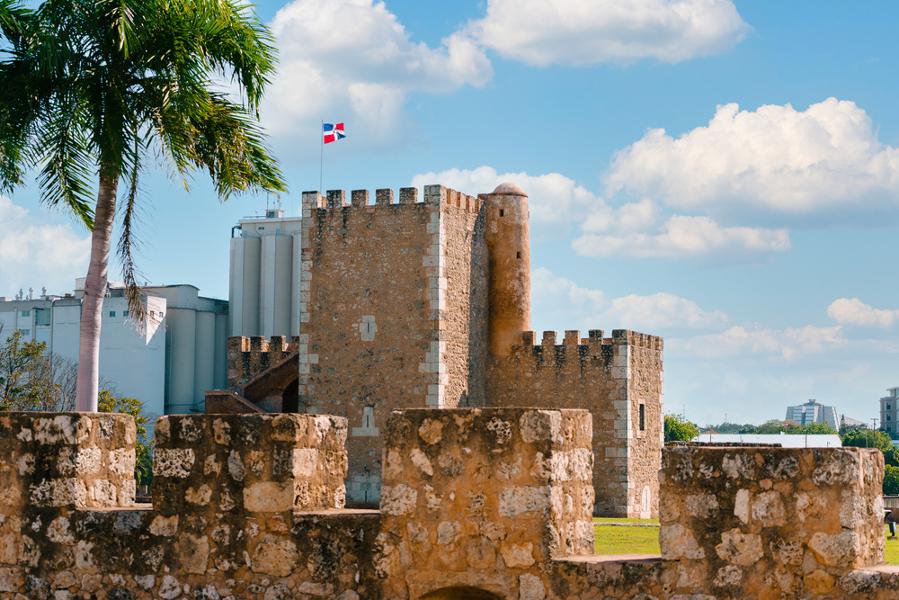
Designed in the early 16th century, between 1502 and 1505, the fortress of Santo Domingo (or "Fortaleza de Ozama") is the first military fort in the American continent. Erected at the mouth of the Ozama River (where it meets the Caribbean Sea), the building served to monitor ships entering the port and protect the city from potential attacks and invasions - French, English, or Portuguese.
The structure of the fort evolved over the centuries, with several additions and modifications to the original architecture, which gave it a medieval style inspired by Spanish fortifications.
During your visit, you can climb to the top of the Torre del Homenaje tower (which once served to watch for the arrival of Caribbean pirates) and enjoy the 360-degree panoramic view. Above the Polvorín gate, take time to admire the statue of Saint Barbara (the patron saint of artillery).
Practical Information Address: C. Las Damas 1, Santo Domingo 10210 Opening Hours: daily from 9:00 AM to 5:00 PM, except Thursdays, Sundays and Mondays Admission: 70 pesos per person (approximately €1.50). Audio guide available (€3). |
The Alcázar of Colón
Less than a ten-minute walk from the park, you will find the Alcázar of Colón (or Palacio Virreinal De Diego Colon). This is the residence of Diego Colón (Christopher Columbus's son and the husband of Maria de Toledo). The monument displays a mix of Renaissance, Gothic, and Moorish architecture. Its distinctive feature? This stone palace was entirely designed without a single nail!
In addition to being a residence, this building also played a major political role, as it once hosted emblematic figures of the Spanish conquest. Restored in the 20th century, the palace has been converted into a museum. You can visit the different rooms of the palace, as well as admire musical instruments, furniture, and artworks.
Practical Information Address: F4G8+WWG, Plaza de España, Santo Domingo 10212 Opening Hours: Tuesday to Sunday from 9:00 AM to 5:00 PM Admission: Approximately €1.50 per person. |
Colón Park
In the heart of the colonial district, don't miss Parque Colón. Known for its vibrant atmosphere, where tourists, locals, and street vendors meet, it's also an ideal place to take a break in the shade between visits, enjoy a coffee, or have an ice cream. Its special feature? You'll likely have the chance to witness some dance moves or a live concert.
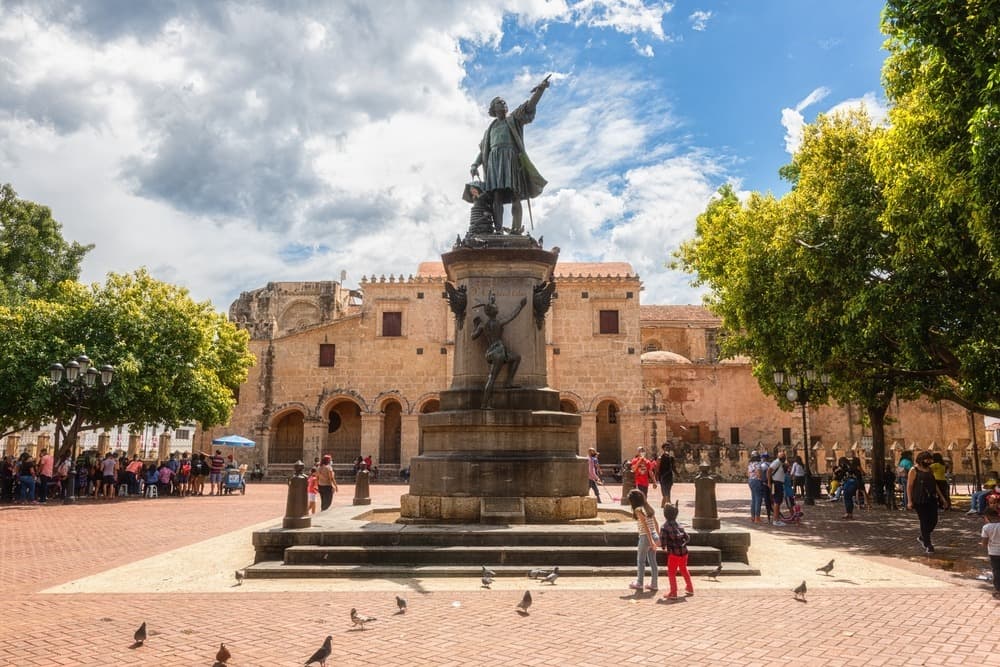
During your stop in the park, you can admire the Palacio del Consistorial (the town hall). This building, in neoclassical style, features a 29-meter-high tower and a beautiful clock. In the heart of the park, you can also see a bronze statue of Christopher Columbus with the Basilica of Santa Maria la Menor as a backdrop.
The Cathedral of Our Lady of the Incarnation (Santa María la Menor)
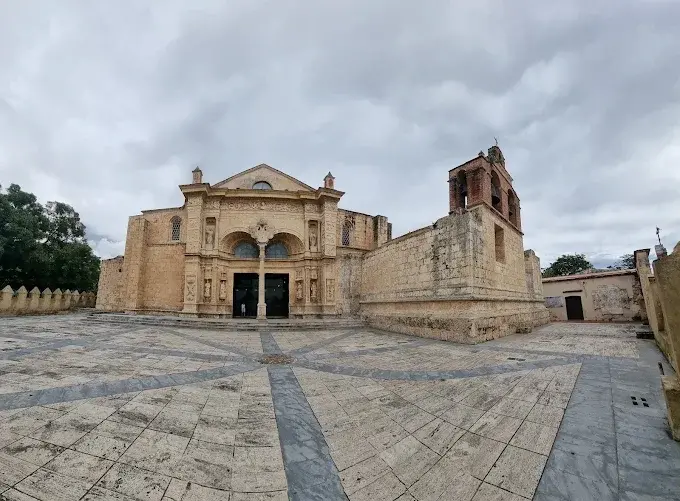
The Cathedral of Santa María la Menor (also called the Cathedral of Our Lady of the Incarnation) is an emblematic building in the Colonial Zone, as it is the very first cathedral built on the American continent.
Dating from the early 16th century, the building was constructed from coral stone and is distinguished by its multicultural architecture, featuring Romanesque, Gothic, and Renaissance styles. On its facades, you can also admire sculptured motifs inspired by the plateresque style - an architectural style bridging Gothic and Renaissance art.
The cathedral's distinctive feature is that it has no bell tower. Initially planned in the project, it could not be built due to a lack of labor and resources, caused by successive changes in colonial authorities.
Practical Information Address: Cjón. de los Curas, Santo Domingo 10210, Opening Hours: Monday to Saturday from 9:00 AM to 4:00 PM Admission: €1.20 / €1.50 with audio guide |
El Conde Pedestrian Street
El Conde Street is one of the main thoroughfares in the Colonial Zone. This pedestrian street, which connects Independence Park to Calle Las Damas (passing through Parque Colón), was named in honor of the Count of Peñalva, governor of Hispaniola Island in the 17th century.
At the entrance to the street, you can admire the historic Puerta del Conde gate (where Dominican independence was proclaimed in 1844) before strolling in search of souvenirs (such as Dominican rum, wooden sculptures, local craftsmanship, etc.)
Note that El Conde Street is an area where you can walk with peace of mind, thanks to the presence of Politur - the tourist police responsible for assisting travelers in case of need.
The Ruins of the Nicholas of Bari Hospital
Built in 1503, the San Nicolás de Bari Hospital (to which the building owes its name) is the Dominican Republic's very first hospital. Equipped with a central nave and two lateral chapels, the hospital facility was used until the 18th century.
The building was subsequently struck by numerous events over the centuries, including a violent 18th-century earthquake that significantly damaged the structure. Today in ruins, the site nevertheless preserves beautiful period structures, where you can distinguish Gothic ogives, Roman-style arches, and bas-reliefs adorned with floral motifs.
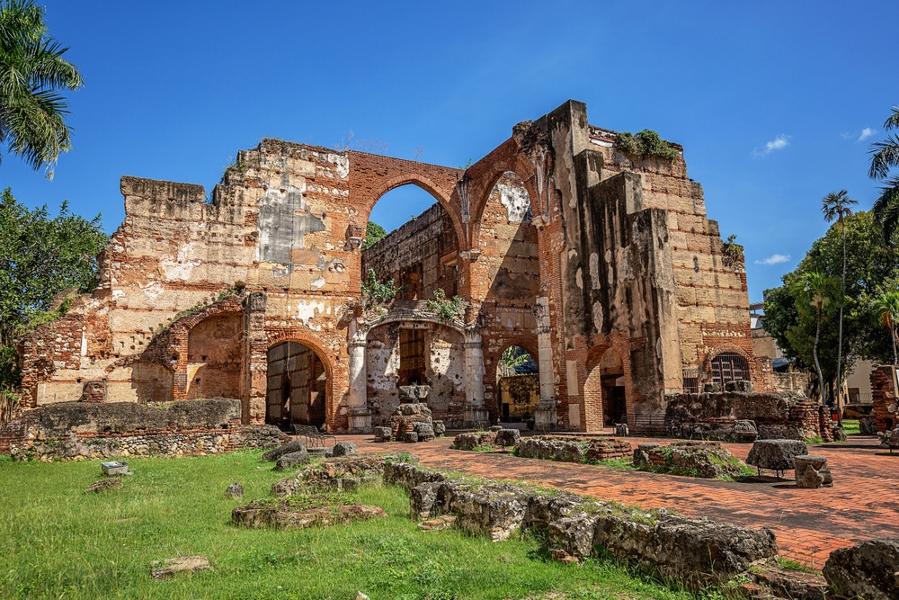
Practical Information Address: C. Hostos 356, Santo Domingo 10210 Opening Hours: open 24/7 Admission: free access |
The Convent of the Dominicans
The Convento de los dominicos was designed in the 16th century to welcome Dominican friars - to whom the first university of the Americas owes its existence. Upon their arrival on Hispaniola Island, the first friars, including Fray Antón de Montesinos, had a conflict with the colonists on the island concerning the enslavement of the Taínos - an indigenous ethnic group.
Beyond its historical past, the convent boasts beautiful colonial architecture. Among other things, you can observe the superb Capilla del Santísimo Sacramento chapel.
On the grounds of the establishment, you can also see a work by Canadian sculptor Timothy P. Schmalz, representing a homeless Christ lying on a bench and covered with a simple blanket. The artwork, named Homeless Jesus, evokes precarity. Its distinctive feature? It is one of 100 copies displayed around the world.
Practical Information Address: F4C7+HWV, C. Padre Billini, Santo Domingo 10210 Opening Hours: daily from 8:30 AM to 12:30 PM, then from 3:00 PM to 6:00 PM |
The Museum of Las Casas Reales
To learn more about Santo Domingo's colonial era, don't hesitate to visit the Las Casas Reales Museum. In addition to understanding the full complexity of this era, your visit will allow you to discover a 16th-century palace, which once served as the seat of Spanish government institutions.
Practical Information Address: C. Las Damas, Santo Domingo 10210 Opening Hours: Tuesday to Friday from 10:00 AM to 6:00 PM Admission: €1.50 per person. Audio guide available. Allow approximately 2 hours for your visit. |
Columbus Lighthouse
On the other side of the Ozama River, discover the Columbus Lighthouse. More than just a building, it is both a museum and a mausoleum dedicated to Christopher Columbus. Inaugurated in 1992 to commemorate the 500th anniversary of the discovery of the Americas, the lighthouse is said to house the remains of the famous navigator...
However, disagreement between Spain and Santo Domingo persists on this subject! To put it simply: after his death in 1505 in Valladolid, Columbus's remains were moved and transferred several times to different locations.
During one of these multiple moves, some bones are said to have remained in Santo Domingo, which Spain contests. For its part, the Dominican Republic refuses any DNA testing! In any case, the site is still worth taking time to visit, if only to admire its distinctive cross-shaped architecture.
The Aerial Tramways of Santo Domingo
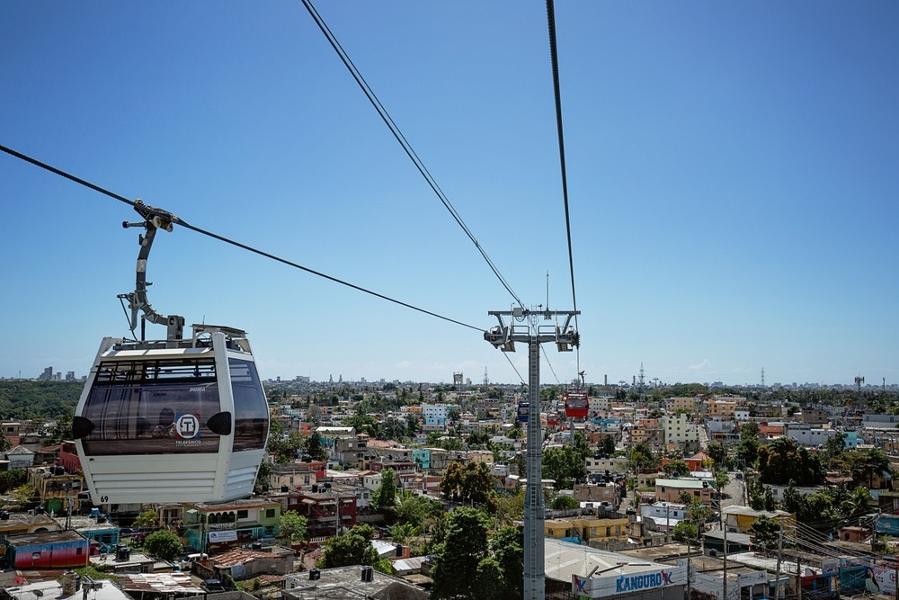
To facilitate transportation in a city undergoing rapid expansion, Santo Domingo has been equipped with two cable car lines:
The T1, inaugurated in 2018, has 195 cabins and connects the two banks of the Ozama River.
The T2, launched in 2023, has 157 cabins and serves 23 neighborhoods to the west of the city.
Each line carries approximately 5,000 passengers per day and thus contributes to easing road traffic. The Teleféricos Santo Domingo are not tourist attractions, but don't hesitate to take a brief round trip on line T1 to enjoy the lovely panoramic view (less than €1 for a ticket).
The Malecón Waterfront
The Malecón (popular nickname for George Washington Avenue, which actually means "waterfront promenade") is a beautiful seaside avenue that stretches along the coast for 14 km. The waterfront can be explored by bike or on foot and offers superb views of the open sea and the Caribbean.
During your stroll, you can admire the Macho Obelisk. It is an important monument for the city. Erected in 1936, under the regime of dictator Rafael Trujillo, the building was later transformed into a symbol of freedom and resistance to the dictator's fall. You can see notably frescoes illustrating historical figures.
Along the waterfront, you will also find many bars and restaurants, as well as shops and local artisans displaying their works. Ideal for mingling with the local population!
The Botanical Garden
The Botanical Garden of Santo Domingo (also named Jardín Botánico Dr. Rafael María Moscoso) is one of the largest in all of the Caribbean! Spanning nearly 2 million m2, the site is home to more than 69,000 botanical species, 300 orchid species, and numerous birds.
The garden was inaugurated in 1976, with the aim of preserving endemic flora. The garden is also equipped with ponds, aquatic plants, fish, and several departments dedicated to horticulture and botany, as well as the Ecological Museum, which allows you to discover the different ecosystems of the Dominican Republic.
Among the emblematic elements of the garden, you will also find the Floral Clock with its 5-meter-long hands - it actually tells the time!
The visit can be done on foot or aboard a small train. The botanical garden also houses a Japanese garden, decorated with bamboos, Asian flowers, and a torii. Admission: €5 per person. Don't hesitate to check the official website to be aware of events and guided tours: https://www.jbn.gob.do/
Visiting Santo Domingo with Young Children - Is It Possible? Except in the Colonial Zone and around the main tourist sites, Santo Domingo is not an ideal destination with young children. Indeed, roads are often not adapted for pedestrians (and strollers), as they are not always equipped and frequently lack sidewalks. |
What to See and Visit Around Santo Domingo?
Los Tres Ojos National Park
About ten kilometers from the city, set out to discover Parque Nacional Los Tres Ojos - or the park "of the three eyes," in reference to the three pools at the site, whose turquoise waters evoke three large blue eyes.
In just a few minutes by car outside the city, you will transition from urban bustle to a calm and mysterious place, dotted with strange cavities... These excavations are, precisely, geological structures of the cenote type (karst sinkholes, often resulting from cave collapse). These caves are easily accessible; you can rent an Uber to get there.
Practical Information Opening Hours: Tuesday to Saturday from 9:00 AM to 5:00 PM, Sunday from 9:00 AM to 4:00 PM Admission: €3.50 per person (a few cents more if you wish to see the fourth lake accessible only by boat). Note: even if they try to convince you otherwise once you're there, guided tours are not mandatory. Visit duration: 1.5-2 hours. |
Saona Island
Within the framework of a longer stay in Santo Domingo, it may be interesting to venture away from the capital to discover Saona Island. Located in Parque Nacional del Este (also called Cotubanamá National Park), this 110 km² island is renowned for its tropical landscapes and white sand beaches lined with palm trees. The site is home to over 300 bird species and 500 flower species!
Most departures are from Bayahibe, a coastal village located less than two hours' drive from Santo Domingo. Day excursions are offered by local agencies and often include round-trip transport from the capital. Budget between €90 and €150 per person depending on options chosen (speedboat or catamaran, meals included, etc.).
Frequently Asked Questions
How Many Days Do You Need to Visit Santo Domingo?
To fully enjoy Santo Domingo without rushing, it is advisable to spend 3 or 4 days there. In one day, for example, it is possible to visit the Colonial Zone (and its many buildings) as well as other neighborhoods such as Gazcue (with its Victorian homes and National Palace) or Malecón (the waterfront).
Is It Safe to Walk Around Santo Domingo (Is It a Dangerous City)?
Santo Domingo, and more generally the Dominican Republic, suffers from delinquency, with muggings, pickpockets, or car thefts. Nevertheless, crime is quite rare in tourist areas. For a safe trip, avoid walking at night, don't wear jewelry or carry large sums of money with you, and store your valuables. As a precaution, also think about scanning your identification documents and photographing your passport stamp for online backup.
What Is the Best Time to Visit Santo Domingo?
The best time to visit Santo Domingo is December-April, during the dry season. The weather is more pleasant, with less rain and air temperatures oscillating around 25-30°C. Meanwhile, the sea stays quite warm year-round, with an average temperature of 27°C. Note that the rainy season, less conducive to visits, extends from May to October (with risks of tropical storms).
Santo Domingo or Punta Cana: Which Should You Choose?
The choice between Santo Domingo and Punta Cana depends on the type of stay you're looking for. On one hand, Punta Cana suits those who prioritize paradisiacal beaches, resorts, and beautiful beach resorts. On the other hand, Santo Domingo appeals with its colonial heritage, local atmosphere, and urban dynamism.
Frequently asked questions
Most sites in the Colonial Zone are accessible for less than €2 per person. For example, Ozama Fortress and the Alcázar of Colón each cost approximately €1.50. Some sites like the ruins of the Nicholas of Bari Hospital have free access. Budget €5 to €10 to visit all the main colonial monuments.
To get around Santo Domingo, several options are available: the cable car (less than €1), taxis or Uber (recommended for tourists for their reliability and safety), walking in the Colonial Zone (very walkable), and biking along the Malecón. Local public transportation exists but is less advisable for visitors unfamiliar with the city.
It is generally advisable to start with Santo Domingo if you're arriving by plane and wish to combine culture and beach. Spend 3 to 4 days in the capital to explore the Colonial Zone and its surroundings, then head to Punta Cana to relax on its beaches. The bus or car ride between the two destinations takes approximately 2.5 hours.
It is possible to visit the main sites of the Colonial Zone in a single day, particularly during a stopover or an excursion from Punta Cana. In one well-organized day, you can discover Ozama Fortress, the Alcázar of Colón, the Santa María la Menor Cathedral, Colón Park, and stroll down El Conde Street. However, to fully enjoy the city and its surroundings, a stay of 3 to 4 days is recommended.
Santo Domingo is generally safe in tourist areas, but some precautions are necessary: avoid walking alone at night in unfamiliar neighborhoods, don't wear jewelry or carry large sums of money visibly, and be wary of pickpockets in busy areas. Prefer official taxis or Uber to informal transportation. The presence of Politur (tourist police) in the Colonial Zone contributes to visitor safety.