Los Tres Ojos National Park
Los Tres Ojos National Park
At the gates of Santo Domingo, Los Tres Ojos brings together four underground lakes within a network of limestone caves steeped in Taíno history.
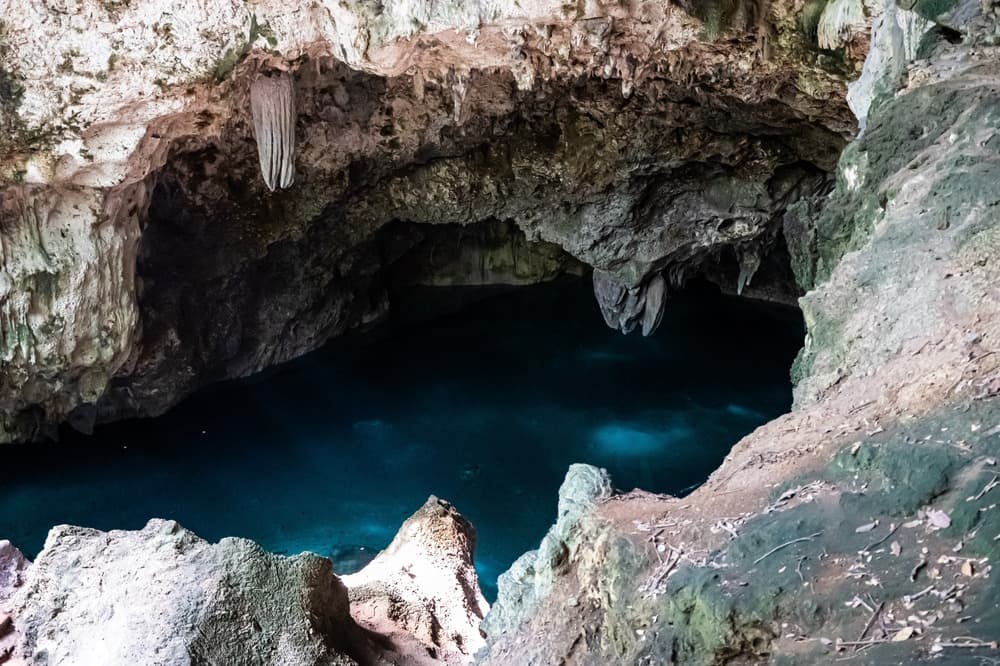
At the gates of Santo Domingo, Los Tres Ojos brings together four underground lakes nestled within a network of collapsed limestone caves. The site, accessible via a stairway and a short boat ride, traces several millennia of Dominican history, from Taíno rituals to Hollywood film shoots. Allow one to one and a half hours to explore it fully.
Why visit Los Tres Ojos
The park combines in a single location several rare attractions in the immediate vicinity of a Caribbean capital: a spectacular geological phenomenon, a pre-Columbian archaeological site, and cave biodiversity. The four basins, fed by an underground river, display blue, green, or yellow reflections depending on their depth and the light. Remains of Taíno culture, still visible at the surface, recall that these caves were a sacred place for the first inhabitants of Hispaniola.
Access is on foot from Avenida las Américas, making it one of the easiest nature outings to organize from Santo Domingo.
History and formation of the site
The name Los Tres Ojos means "the three eyes," referring to the eye-shaped form of the three first lakes visible from the path. The site was formed as a result of tectonic fractures that caused the collapse of limestone caves. These subsidences created several cavities, later filled by the waters of an underground river.
Long before its opening to the public, the place served as a location for religious rituals and fertility rites for the Taíno Indians, the first inhabitants of Hispaniola. The basins, considered sacred, hosted ceremonies and ritual baths. Traces of this pre-Columbian occupation still remain near the lakes.
The four lakes to discover
The visit follows a marked path of 346 steps that descends into the rock and then rises back toward the exit. Each basin has its own character.
Sulfur Lake
The first lake encountered upon arrival, it owes its nickname to the whitish areas that mark its walls. Long believed to be sulfur, these traces were revealed, after analysis, to be calcium deposits. The water takes on a light blue hue under the light filtering through the cave opening.
Lake of the Ladies
A small basin 2.4 meters deep, it is said to have served as a bath for women and children in pre-Columbian times, earning it its present name. An observation platform overlooks the water beneath a vault of stalactites.
Lake La Nevera
The second largest basin on the site, it is also the coolest: its temperature ranges between 15 °C and 21 °C, compared to 20 °C to 29 °C for the other lakes. Sunlight rarely reaches it, which darkens its waters. Access is by wooden boat pulled by hand—a short journey included in the entrance fee.
Zaramagullones
The fourth and final lake, open to the sky, reaches 7.6 meters in depth. Its name comes from a local aquatic bird. Bordered by cliffs and tropical vegetation, it has served as a location for several film shoots, including Tarzan, Combat Shock, Jurassic Park III, and Oro y Polvo. Taíno remains are most visible here.
Fauna and vegetation
The ecosystem combines cave environments and tropical vegetation. You will encounter freshwater fish in the basins, bats clinging to the vaults, and migratory birds taking advantage of open-air passages. A few reptiles and amphibians occupy the periphery. The walls and surroundings are colonized by ferns, endemic trees, and climbing plants.
Practical information
The site is visited on foot, following a single path. Bring good shoes: there are many steps and some may be damp. A flashlight is not necessary, as the path is lit.
- Average visit duration: 1 to 1.5 hours
- Path: 346 steps total
- Fee: moderate, paid on-site
- English-speaking guides available at the entrance
When to go
The site is open during the day from 9 a.m. to 5 p.m. and illuminated in the evening with colored lighting displays. An early morning visit is recommended: natural light then penetrates the caves and reveals the full palette of colors in the basins. This is also when crowds are smallest, before tour groups arrive mid-morning.
How to get there
Los Tres Ojos is located on Avenida las Américas, within the grounds of Mirador del Este park, east of the Ozama River. From Santo Domingo's historic center, allow 15 to 25 minutes by taxi depending on traffic. Numerous excursions from the capital or beach resorts on the east side of the country include a stop at the site, often combined with the Colonial Zone.
Nearby attractions
Mirador del Este park, which surrounds the caves, offers a green space enjoyed by locals for walking. To extend your underground exploration, the Cave of Wonders features remarkably preserved Taíno rock paintings. On the aquatic side, Dudù Lagoon offers a comparable cenote in a tropical setting, and the colonial site of Altos de Chavón rounds out a cultural circuit on the eastern side of the island.
Frequently asked questions
Frequently asked questions
Plan your trip
To incorporate Los Tres Ojos into a complete circuit combining nature, Taíno culture, and colonial heritage, consult our customized trips to the Dominican Republic.
Interested in this visit?
We can include it in your personalised itinerary.